
What Is IDV in Vehicle Insurance
Table of Contents
What Is IDV in Vehicle Insurance?
What Is IDV?
How IDV Affects Your Insurance
How IDV Is Calculated
IDV for New vs Old Vehicles
Common Myths About IDV
How to Choose the Right IDV
FAQs
What Is IDV in Vehicle Insurance?
When buying or renewing motor insurance, one of the most important terms you will come across is IDV. It affects your premium, claim amount, and overall policy value. Understanding what Is IDV in vehicle insurance helps car and bike owners make informed decisions and avoid financial loss during accidents or total damage situations. This is why many policyholders search for what Is IDV in vehicle insurance before choosing a plan, as knowing what Is IDV in vehicle insurance helps avoid major mistakes during renewal.
What Is IDV?
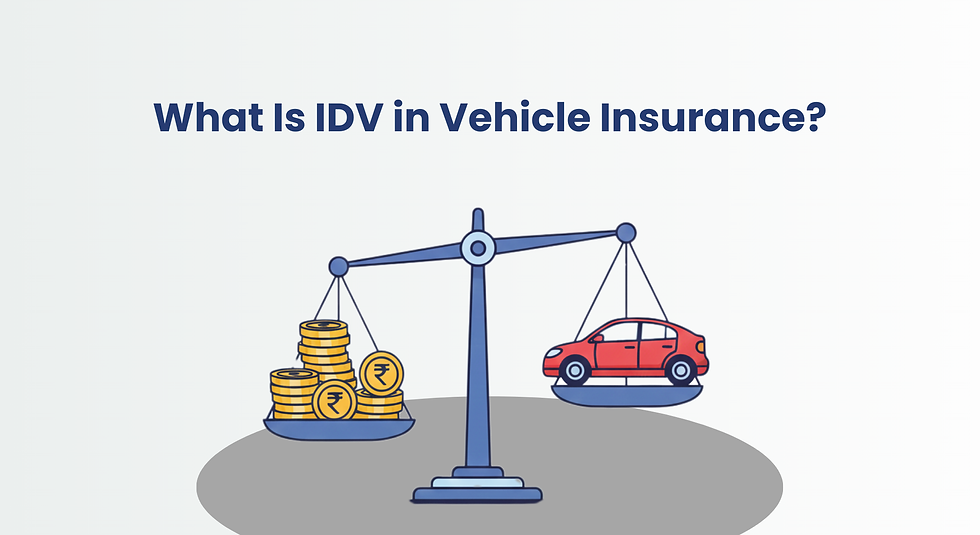
IDV (Insured Declared Value) is the current market value of your vehicle. It is the maximum amount your insurer will pay if the vehicle is: Stolen Completely damaged (total loss) Burnt in fire Destroyed in a severe accident IDV represents the estimated resale value of the vehicle at that point in time, and this is the core reason people must understand what Is IDV in vehicle insurance before selecting coverage.
How IDV Affects Your Insurance
IDV directly impacts:
Claim Amount Higher IDV → Higher claim payout
Lower IDV → Lower claim payout
Premium
Higher IDV → Higher premium
Lower IDV → Lower premium
Choosing extremely low IDV may reduce your premium today but leads to significant loss during claims. This again highlights why learning what Is IDV in vehicle insurance is crucial for buyers who want long-term financial safety.
How IDV Is Calculated
IDV is calculated using:
IDV = Manufacturer’s Listed Price – Depreciation + Insured Accessories Value
Standard
Depreciation Rates: 6 months old → 5% depreciation
6 months–1 year → 15%
1–2 years → 20%
2–3 years → 30%
3–4 years → 40%
4–5 years → 50%
For vehicles older than 5 years, the IDV is decided mutually between the owner and insurer after inspection. Because of this variation, people often look up what Is IDV in vehicle insurance to understand why their IDV changes every renewal.
IDV for New vs Old Vehicles
New Vehicles IDV is high due to lower depreciation. Claims result in higher compensation.
Older Vehicles Depreciation increases every year. IDV reduces as the vehicle ages, lowering the claim value.
Even older vehicles should not select the lowest IDV available—balanced coverage is important, which is a key principle in what Is IDV in vehicle insurance.
Common Myths About IDV
Myth 1: Low IDV always saves money It reduces premium but increases financial risk.
Myth 2: IDV should match purchase price IDV decreases every year due to depreciation.
Myth 3: Accessories don’t affect IDV Expensive accessories (alloys, infotainment systems, CNG kits) increase the IDV if insured.
Myth 4: IDV and resale value are the same Resale value varies by condition; IDV follows a standard calculation.
How to Choose the Right IDV
To select the correct IDV:
Avoid the very lowest IDV (risk of poor claim payout)
Avoid extremely high IDV (unnecessary premium increase)
Compare IDV across insurers before buying
Choose an IDV close to actual market value
Consider vehicle age and usage
Review policy terms for total loss or theft
Balanced IDV = Better protection + reasonable premium
This approach is at the heart of what Is IDV in vehicle insurance guides shared by experts.
Understanding what Is IDV in vehicle insurance helps car and bike owners choose appropriate coverage and claim benefits. IDV influences both premium and compensation, making it one of the most important parameters in motor insurance. Always select a balanced, realistic IDV based on your car’s current value and usage. Anyone learning what Is IDV in vehicle insurance will quickly see how important this single number is for their financial protection.
FAQs
1. What does What Is IDV in Vehicle Insurance actually mean?
Understanding What Is IDV in Vehicle Insurance is essential because IDV meaning refers to the current market value of your car or bike. Insurers use this value to determine the compensation in case of total loss or theft.
IDV includes:
Present car insurance value
Depreciation-adjusted price
Insured accessories value.
This makes IDV one of the most important calculations in motor insurance.
2. How is vehicle insurance IDV calculated during policy renewal?
To understand calculation, you must first know What Is IDV in Vehicle Insurance. IDV is computed using the manufacturer’s listed selling price minus depreciation. Insurers also add the value of insured accessories.
Key factors:
Depreciation slab based on vehicle age
Brand/model market value
Additional accessories
This formula ensures the IDV meaning stays close to real resale value.
3. Why does choosing the right IDV matter in car insurance?
Knowing What Is IDV in Vehicle Insurance helps you avoid financial loss. A higher IDV increases the claim payout, while a very low IDV reduces both premium and compensation.
Right IDV ensures:
Fair claim in total-loss cases
Accurate car insurance value
Balanced premium vs. coverage
This is why IDV matters more than any other number in motor insurance.
4. Does IDV reduce every year? If yes, why?
Yes, IDV decreases yearly, and understanding What Is IDV in Vehicle Insurance explains why. Depreciation reduces the car’s resale value, and insurers apply standard percentage deductions.
Annual IDV drop depends on:
Vehicle age
Wear and tear
Market depreciation trends
This reduction keeps the vehicle insurance IDV aligned with real-world prices.
5. How do I select the best IDV for my car insurance policy?
Selecting IDV becomes easier when you understand What Is IDV in Vehicle Insurance. The ideal IDV should reflect your car’s true market worth—not too high or too low.
Choose IDV based on:
Current resale value
Age and usage of vehicle
Insurer’s offered range
A realistic IDV ensures correct compensation and avoids unnecessary premium hikes.


Comments